IBM i P05 on Power S1112: What the Entry Tier Actually Allows
The IBM Power S1112 is the first Power 11 server for IBM i P05 customers, but the opportunity is defined by clear boundaries around cores, memory, partitions, and side workloads.
Jump to the exact AS400 software question you want answered.
Why P05 matters more than it sounds
P05 is not a marketing adjective. It is the IBM i software-tier boundary that often shapes hardware affordability, third-party software pricing, and the size of refresh projects smaller shops can realistically approve.
That is why the S1112 matters. IBM's July 2026 launch finally gave IBM i P05 customers a Power 11 path, which means buyers no longer have to treat current-generation hardware as something reserved only for larger software-tier footprints.
What IBM actually allows on the S1112
IBM's platform support details and S1112 limitations page define the practical IBM i boundary much more clearly than launch marketing does. For IBM i logical partitions on the S1112, IBM says support is P05 only, with a maximum of four cores, 64 GB of memory, and four IBM i logical partitions per server.
- IBM i support on S1112 is for Software Tier P05 only
- IBM i logical partitions are capped at a cumulative maximum of four cores
- IBM i logical partitions are capped at a cumulative maximum of 64 GB of memory
- The server supports up to four IBM i logical partitions, with fewer possible if a partition is assigned more than one virtual processor
- IBM says the system supports up to 12.8 TB of internal NVMe storage, with 6.4 TB usable for mirrored IBM i storage
What P05 does not limit
The IBM i limit is not the same thing as a whole-server limit. IBM's S1112 limitations page explicitly says Linux, AIX, and VIOS logical partitions can use remaining processor and memory resources on the server. That point is where Midland's analysis adds real buyer value.
Midland correctly frames the extra headroom as a side-workload story rather than a promise that one IBM i partition suddenly gains access to all ten cores in a larger configuration. For buyers planning APIs, web fronts, monitoring components, or AI-adjacent services beside IBM i, that distinction matters.
Why buyers care about this boundary
This is where the S1112 becomes more than another model announcement. A smaller IBM i shop can keep IBM i inside a documented P05 boundary while still modernizing the surrounding environment on current hardware.
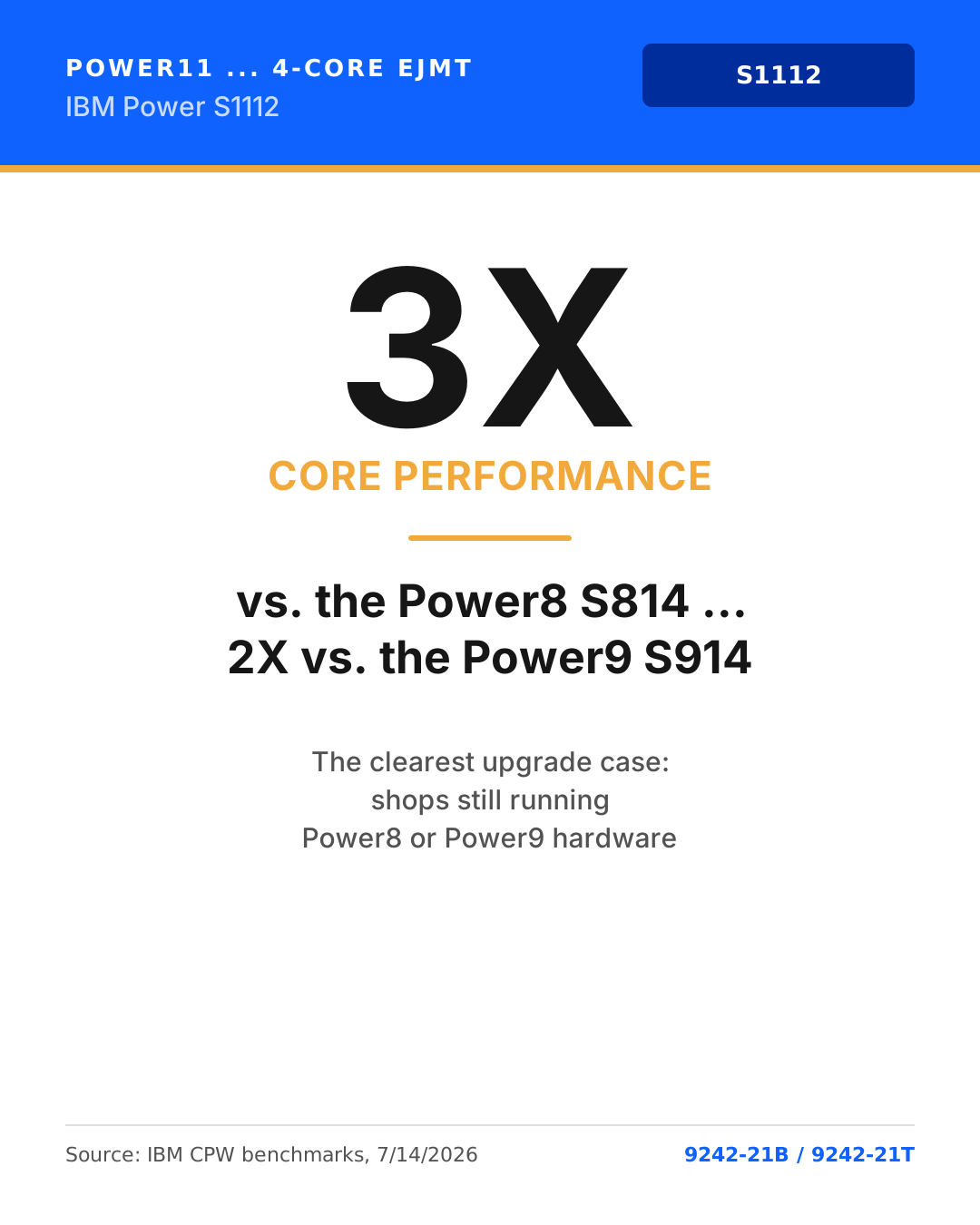
That can mean pairing IBM i with Linux integration services, supporting Bob-driven modernization work, or simply refreshing an older Power 9 or early Power 10 entry system without immediately converting the whole project into a higher software-tier event.
Questions to settle before you quote it
The most important S1112 planning questions are commercial and architectural, not cosmetic.
- Will the system run only IBM i, or do you expect Linux, AIX, or VIOS side workloads too?
- Do your IBM i and ISV license assumptions still hold once the partition design is documented?
- Are you buying the platform for a plain refresh, or as part of a Bob, API, or AI-era modernization plan?
- Do your storage needs stay realistic inside the mirrored IBM i NVMe boundary IBM documents?
Sources
- IBM Support: IBM i Platform Support Details
- IBM Docs: IBM i limitations for IBM Power S1112
- IBM Newsroom: IBM launches new Power systems and software built for enterprises to address risk, productivity, and flexibility
- IBM Power S1112 product page
- Power11.AS400IBMSystem.com: IBM S1112 EJMT 4-Core Power 11 Processor System
All sections, listed like article footnotes.
Software catalog pages tied to this IBM Power S1112 topic.
TL2000 Dispatch and Operations
Carrier dispatch and operations software built on the IBM System i, developed by TMW Systems over roughly two decades and now sold by Trimble, with a web edition layered over the original IBM i application.
IBM i Operating System Upgrade Planning
A software planning and services category for IBM i release upgrades, PTF strategy, compatibility checks, and version migration readiness.
Database Replication, Mirroring, and Migration
An replication and migration program for real-time synchronization between heterogeneous databases and platforms with one-way and two-way support.