IBM Power S1112: What the First Power 11 P05 Server Actually Changes
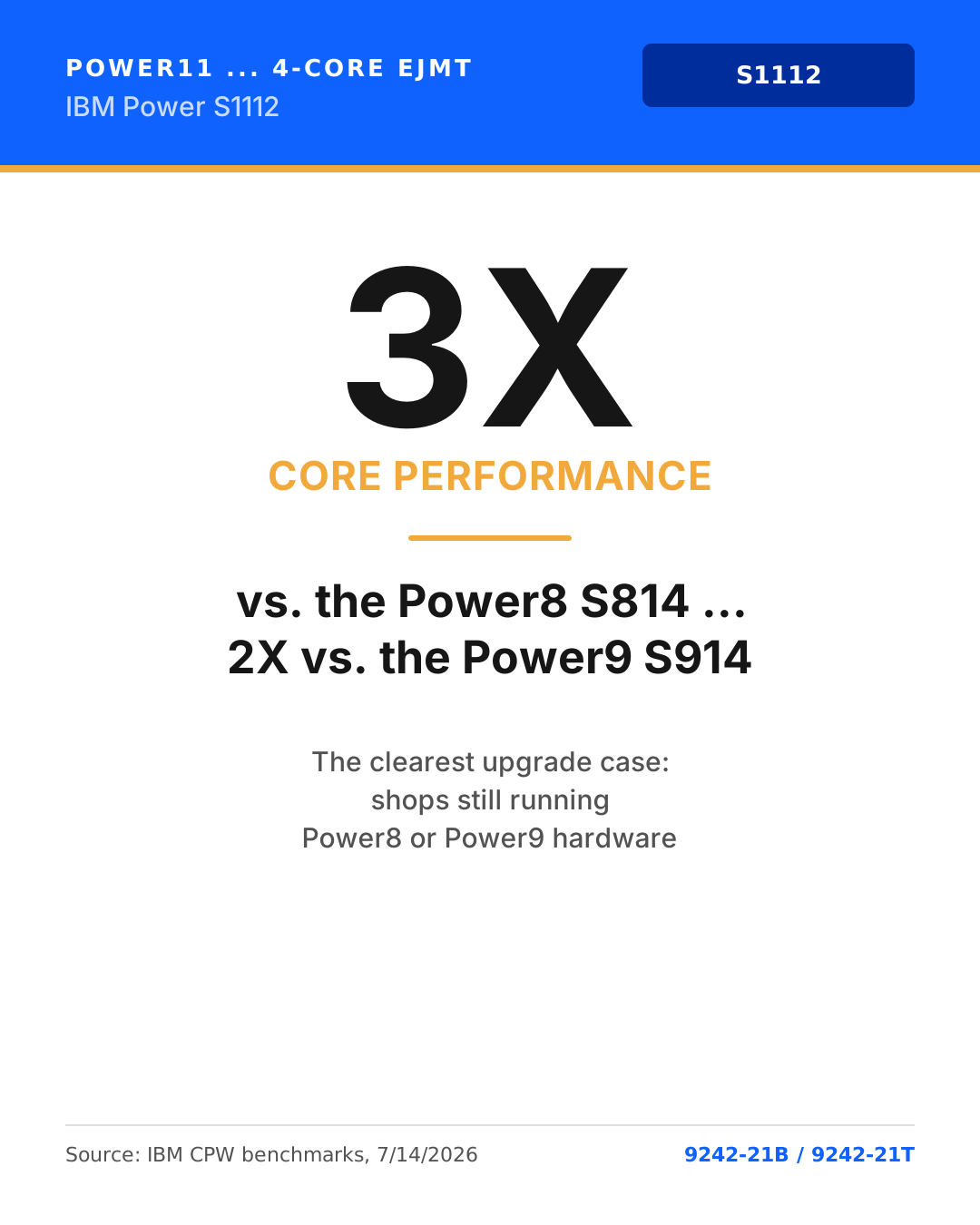
The S1112 is more than a smaller Power 11 box. It gives IBM i P05 buyers a new entry point into Power 11 and a clearer way to pair IBM Bob, Linux side workloads, and compact current-generation hardware.
Jump to the exact AS400 software question you want answered.
What IBM confirmed on July 15, 2026
IBM announced three related items on July 15, 2026: the Power S1112 server, IBM Power Autonomous Operations, and the broader launch framing around IBM Bob Premium Package for i. IBM said the S1112 is expected to be generally available on July 24, 2026, Power Autonomous Operations is expected to be generally available on September 23, 2026, and IBM Bob Premium Package for i had already reached general availability on June 24, 2026.
IBM also described the S1112 as an entry-level, compact Power 11 option powerful enough to run AI inference locally. That is important context for buyers considering side workloads, not just classic IBM i partition sizing.
Why P05 is strategically important
IBM's platform support page is the most important document for serious buyers because it defines the practical IBM i boundary. It says IBM i support on the S1112 is for Software Tier P05 only, that there is a maximum of four IBM i LPARs, and that IBM i LPARs are confined to run within four cores and 64 GB of memory.
That wording makes the S1112 strategically significant for smaller environments. It gives P05 customers a Power 11 path without first forcing them into a higher IBM i software tier just to get onto the current generation.
How the S1112 supports Bob and Autonomous Operations
Bob and Power Autonomous Operations solve different problems. Bob is a development and modernization tool aimed at IBM i application understanding and change. Power Autonomous Operations is an infrastructure operations layer aimed at capacity, alerting, and remedial guidance for Power estates.
The S1112 matters because it gives smaller buyers a current-generation platform that can host the IBM i production partition while still leaving room for adjacent workloads such as Linux web fronts, integration services, monitoring components, or AI-adjacent side services. That does not mean Bob requires this box. It means the box makes the broader modernization stack easier to package and budget together.
The 9242-21B versus 9242-21T question matters
Midland's July 2026 comparison is useful because it pushes past generic launch language and into buyer reality. Midland argues that the platform's flexible boundary design matters more than a simple core count headline, because unused processor and memory capacity can support AIX, Linux, or VIOS workloads without changing IBM i P05 eligibility.
Midland also treats the rack 9242-21B as the model to evaluate when broader expansion headroom matters most. Buyers should treat that as a quoting checkpoint: verify the exact chassis, processor option, and partition plan with IBM or the reseller before assuming the tower and rack paths are identical.
Questions buyers should answer before quoting
The S1112 becomes a stronger purchase when the workload plan is explicit before the quote is built.
- Will the box run only IBM i, or will it also host Linux, AIX, or VIOS side workloads?
- Is the main goal a simple refresh, or a combined refresh and modernization program tied to Bob, APIs, or AI-adjacent services?
- Do you need the rack model because future expansion headroom matters, or does the tower form factor better match the site and support model?
- Which IBM i release and TR or PTF level will the partitions run, and are all third-party vendors certified there?
- What non-IBM-i services are expected to share the machine over the next 24 months, and how much isolation or growth headroom do they need?
Sources
- IBM Newsroom: IBM launches new Power systems and software built for enterprises to address risk, productivity, and flexibility
- IBM Support: IBM i Platform Support Details
- IBM Power S1112 product page
- IBM i 7.5 TR8 enhancements
- Power11.AS400IBMSystem.com: IBM S1112 EJMT 4-Core Power 11 Processor System
All sections, listed like article footnotes.
Software catalog pages tied to this IBM Power S1112 topic.
TL2000 Dispatch and Operations
Carrier dispatch and operations software built on the IBM System i, developed by TMW Systems over roughly two decades and now sold by Trimble, with a web edition layered over the original IBM i application.
IBM i Operating System Upgrade Planning
A software planning and services category for IBM i release upgrades, PTF strategy, compatibility checks, and version migration readiness.
Database Replication, Mirroring, and Migration
An replication and migration program for real-time synchronization between heterogeneous databases and platforms with one-way and two-way support.